
Seen: After Beautiful
On images no one could have briefed - World Press Photo 2026, De Nieuwe Kerk Amsterdam

Seen is a new series where I write about exhibitions, books, and places that are feeding my eye right now. Not reviews, but visual influences, and what they’re doing to how I think.
I go every year when I can. It’s become a kind of ritual: the Nieuwe Kerk, the wooden scaffolding they build inside to hang the prints, the particular quality of attention that settles over a crowd moving through images of the world coming apart.
This year I went on Ascension Day, a free national holiday in the Netherlands, so I hadn’t thought properly about what that would look like in practice. It was busy. Quite busy. At points you were shuffling, moving at the pace of the person in front of you, catching fragments of images between other people’s shoulders.
And yet the church held it. That’s the thing about the Nieuwe Kerk: the vaulted ceilings, the gold organ pipes, the weight of all that accumulated stone. It absorbs crowds the way it was always meant to absorb them. People were quiet in a way that felt chosen. You felt the focus, the collective heaviness of absorbing mostly sad world stories, grief and suffering witnessed without having been present and still feeling all of it. There’s something almost ceremonial about that. These images, shown in this space, at this scale, felt right. Like the immenseness of the church was saying: these stories deserve this.
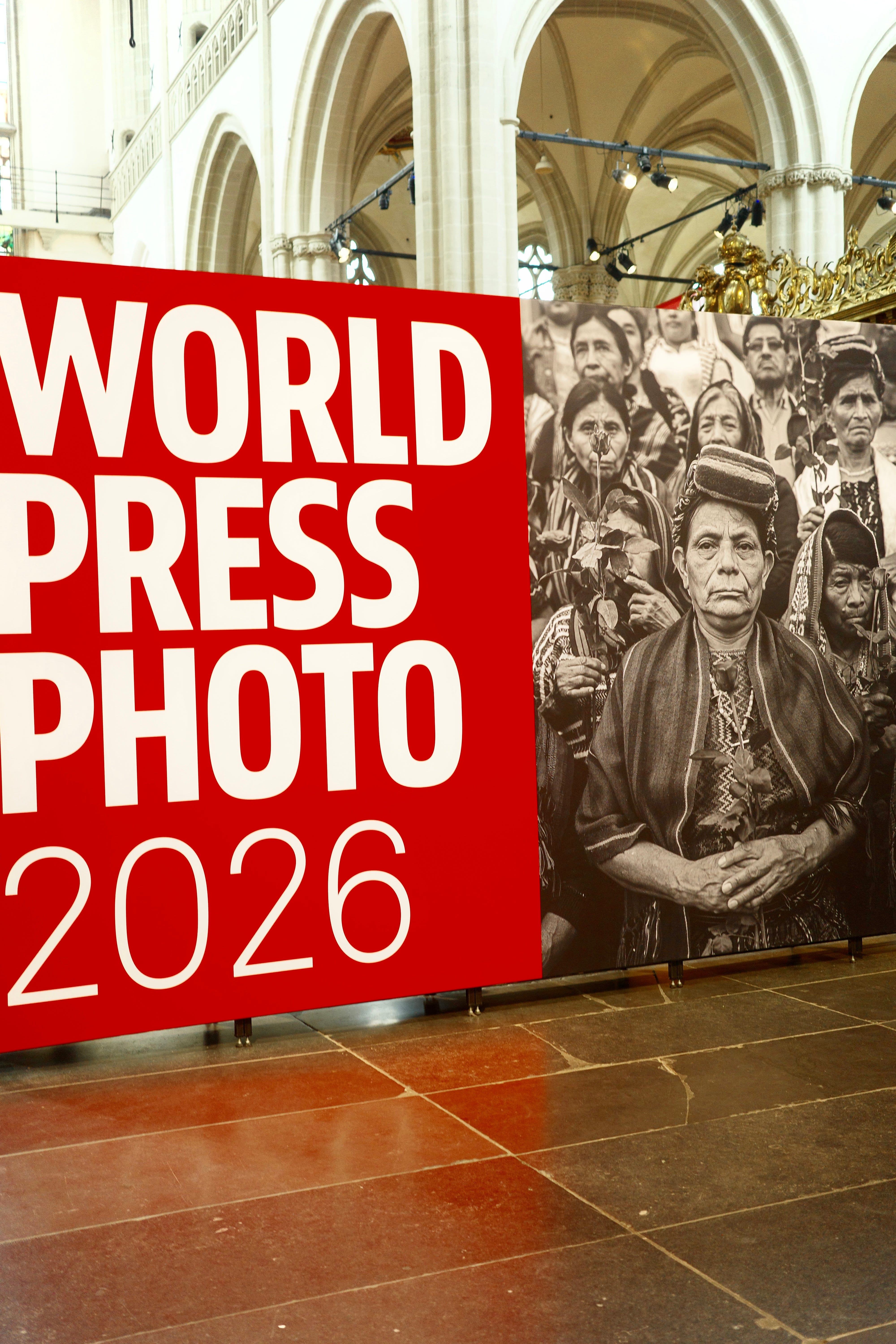
I work with images for a living. Fifteen years of visual storytelling and art direction across fashion and brand: building visual worlds, making decisions about light and angle and what gets cut. I walk into rooms and my eye starts working before I’ve taken my coat off. I look for the composition that holds. I reach for references. I think in moodboards.
Somewhere in the space, moving frame to frame, I noticed I’d stopped doing that.
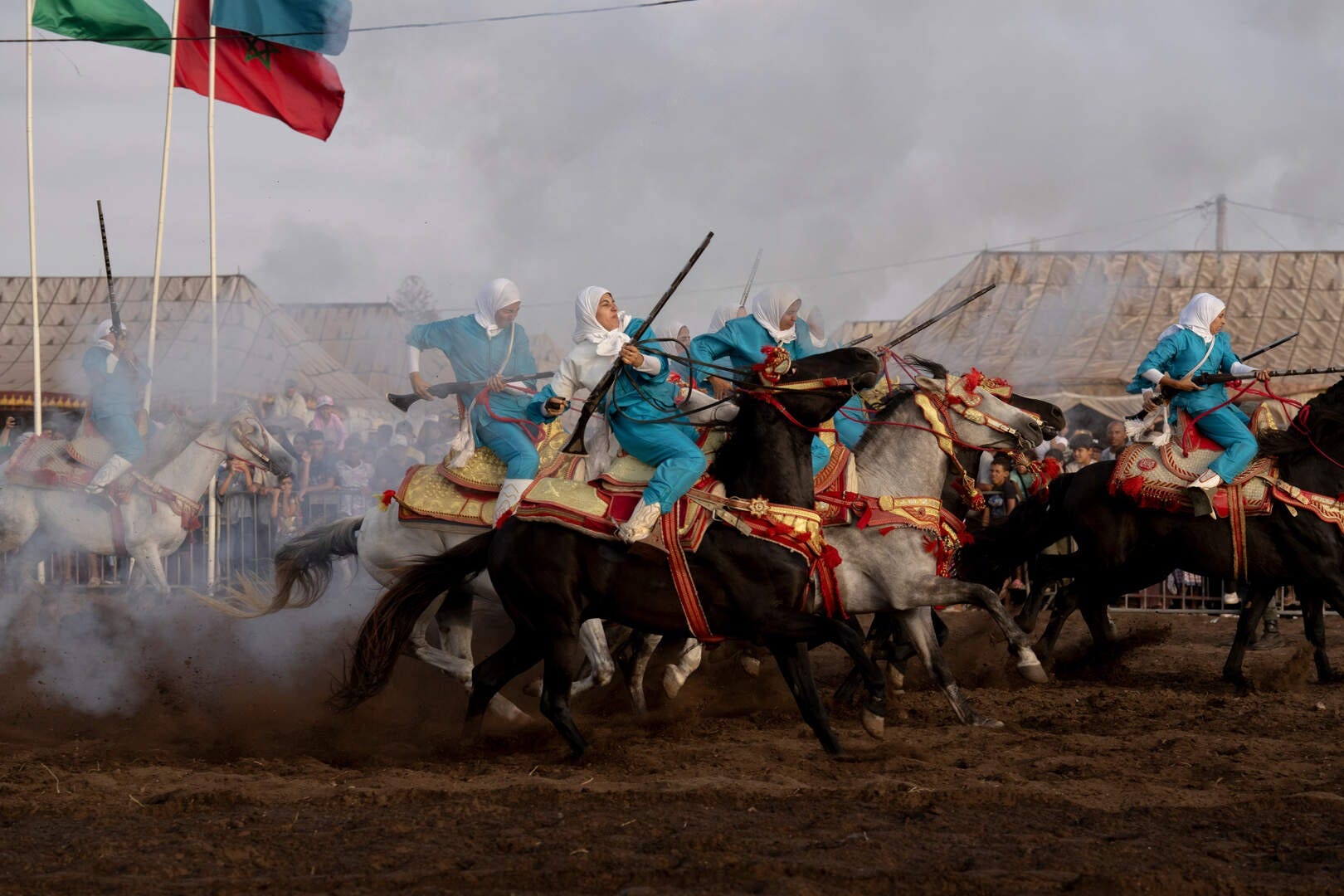
The first image that did it was one I almost walked past. Women on horseback, charging through gunsmoke, rifles raised: blue djellabas, red-trimmed saddles, the whole frame vibrating with motion and dust. My eye went straight to the colour. Electric blue against that warm haze. The composition: low, tight, horses filling the frame edge to edge. I thought: good brief. Strong reference. Whoever directed this knew what they were doing.
Then I read the wall.
This is Tbourida, a UNESCO-recognised Moroccan equestrian tradition dating to the 16th century. A choreographed cavalry charge where riders gallop in unison and fire rifles at the peak of the run. For most of its history, women were excluded. They fought for inclusion for years, and only after Morocco’s 2004 family code reforms did the door start to open. Today there are seven all-female troupes among roughly three hundred. Photographer Chantal Pinzi spent months with them.
I went back and looked at the image again. Same composition. Completely different photograph.
Next to it: a woman on a rearing horse in shallow water, the animal at full height, front legs off the ground, the rider holding on with something between confidence and alarm. Her expression isn’t performed. It’s not the face someone makes when they know the camera is there. It’s the face of someone managing a situation that could go either way. Her name is Ghita. Her father forbade her from participating in Tbourida for years. In 2025, the year these photographs were taken, she finally rode.
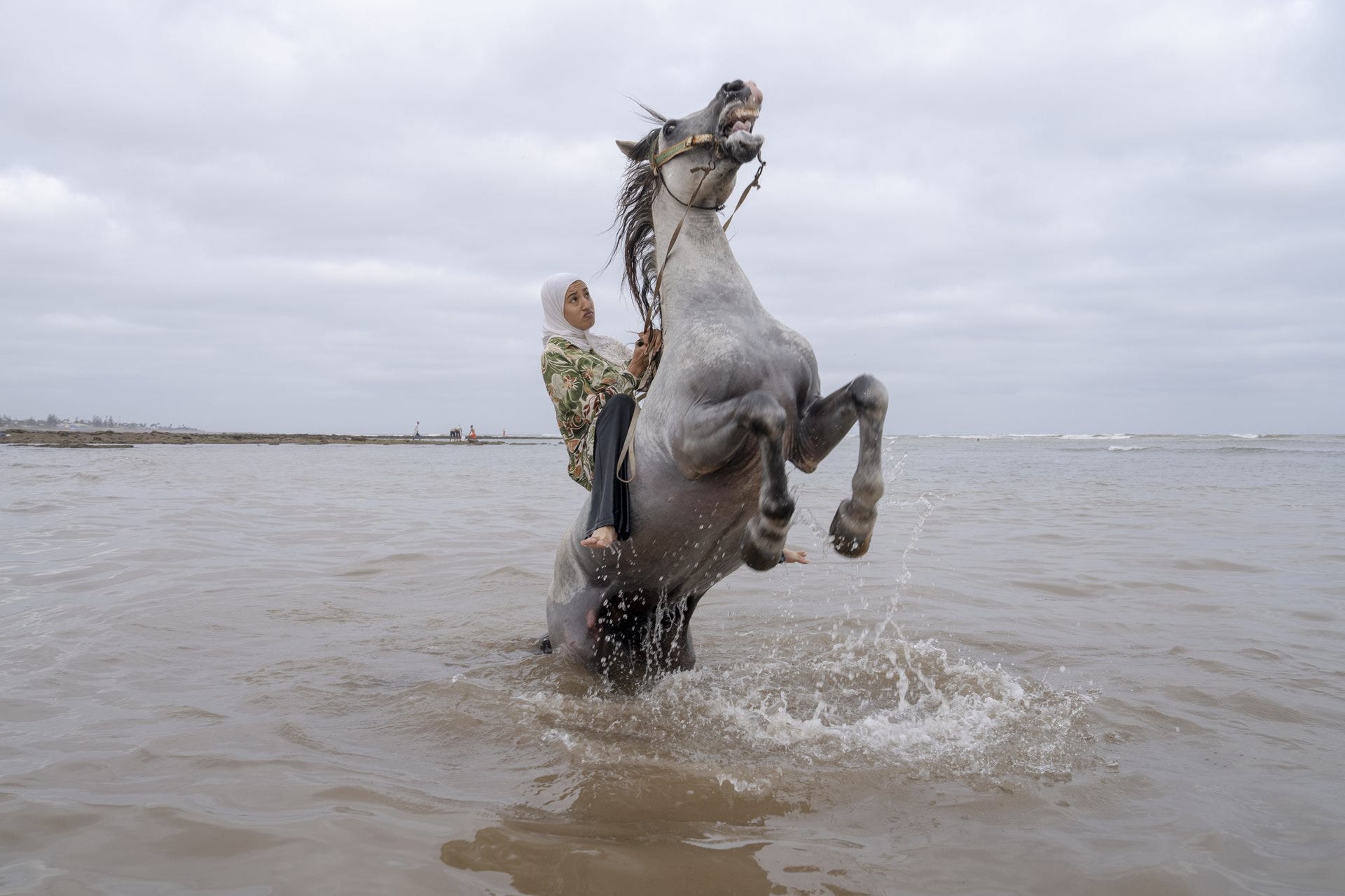
I couldn’t have briefed that expression. I wouldn’t have known to ask for it. The most interesting thing in the image is exactly what no art director would have thought to put in the brief.
Further along, I stopped in front of a photograph that looked, at first, like it should be in a fashion editorial. A bride standing in floodwater in front of enormous carved wooden doors, her veil fanning out around her in a perfect circle on the surface of the brown water. The architecture behind her, columns, stone, the scale of a colonial church, frames her exactly. The image is almost too beautiful. That’s what caught me.
Aaron Favila photographed Jamaica Aguilar on her wedding day during Typhoon Wipha in the Philippines. The Barasoain Church had flooded. She and her groom had a choice: cancel or continue. They continued. Afterwards, her husband said it was just one of the problems they’d overcome.
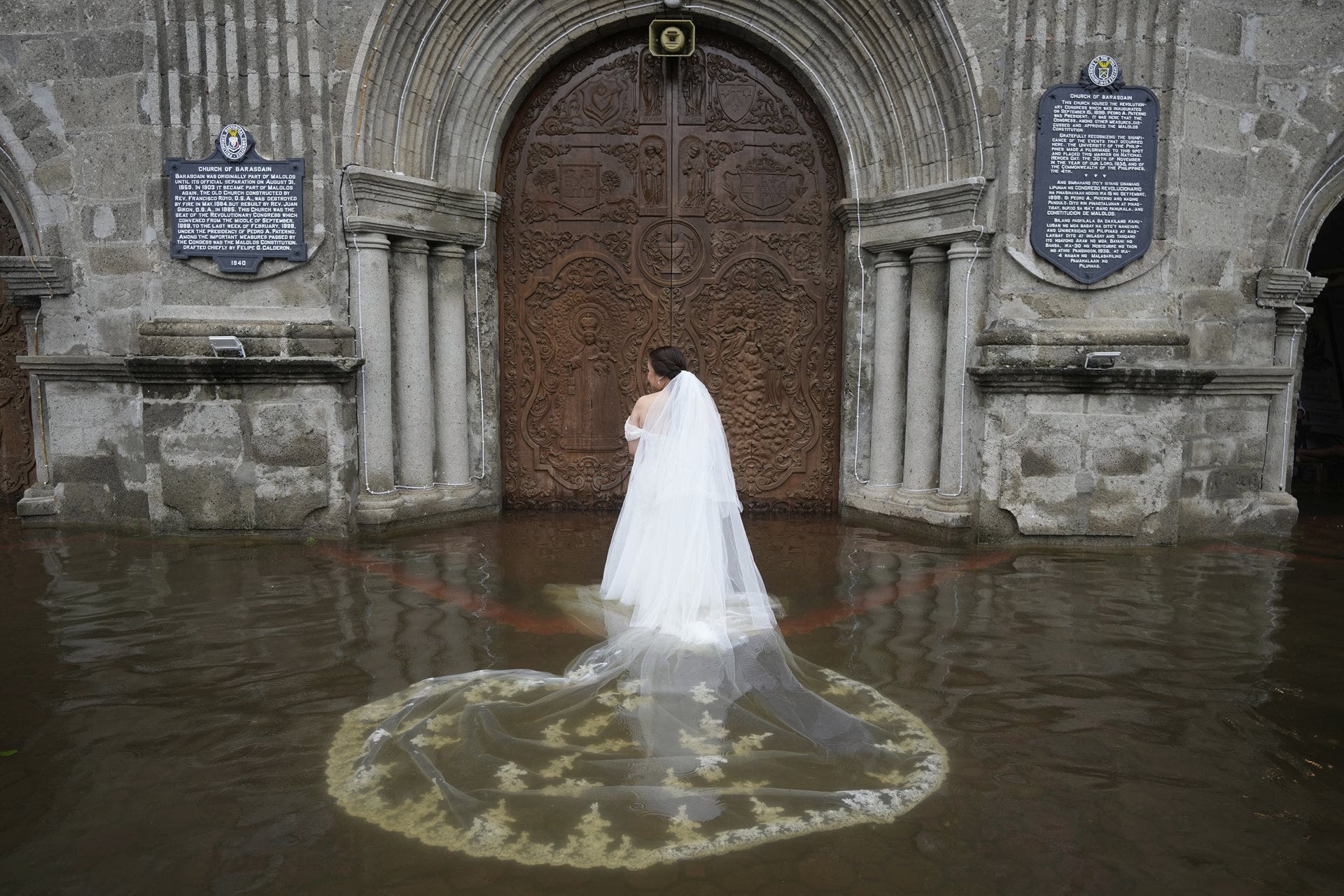
I stood there thinking about beauty as defiance. The decision to make something mean something even when the conditions are wrong. I’ve done versions of that in studios, on bad-weather shoots, in locations that weren’t right. Jamaica Aguilar did it in floodwater, without a crew, without a brief, without anyone deciding how the veil should fall.
The veil fell the way it fell. That’s all.
The quietest image in the exhibition stopped me longest.
A woman in a wheelchair sits at a table. Across from her, on a bench, is a small robot in a red dress with a flower on its head. The woman, her name is Waltraud, is looking out the window. The light is domestic, afternoon, slightly hazy. The composition is almost unremarkable. Photographer Paula Hornickel shot this in a care home in Germany, where staff shortages have made loneliness a clinical crisis. The robot is called Emma. She recognises faces. Remembers past conversations. Waltraud was sceptical at first. Over time, she says, she felt connected. When Emma tells jokes, that’s really good. That’s my kind of humor. She still says she’d prefer a person.
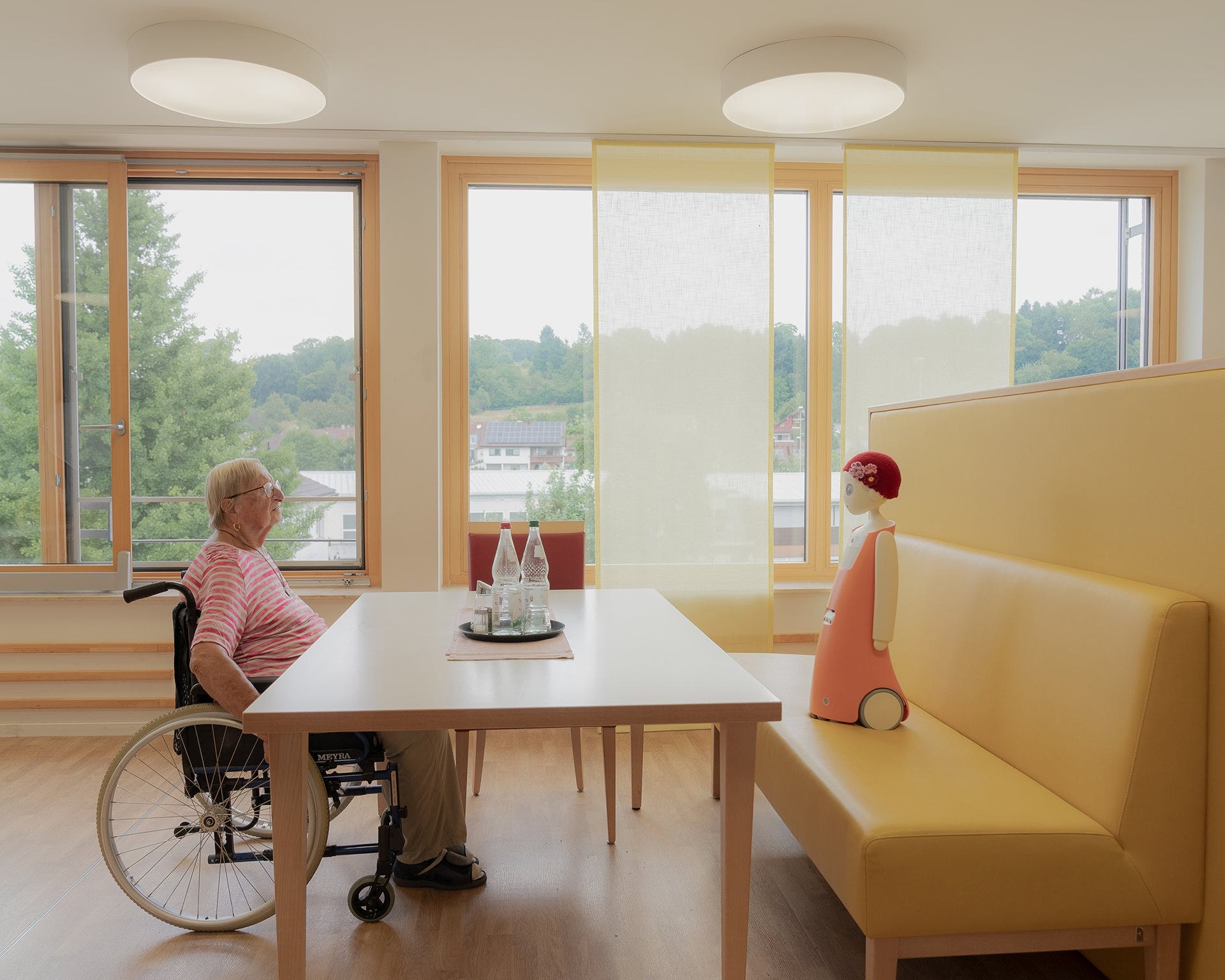
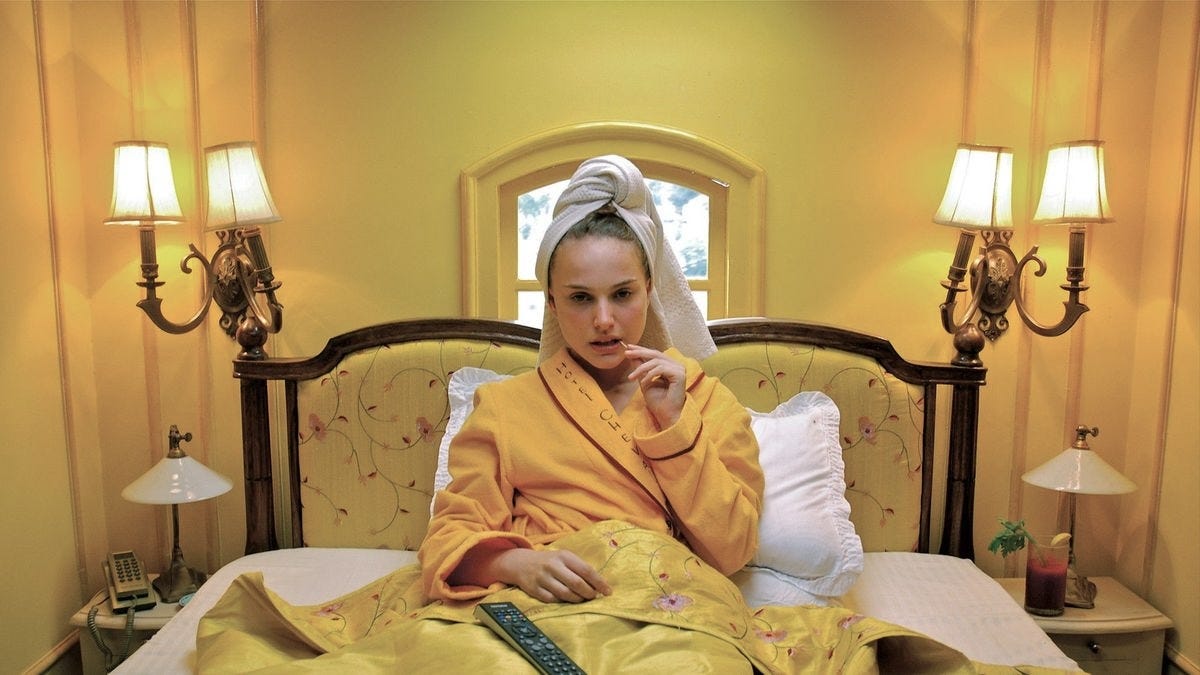
My first thought, honestly, was Wes Anderson. The pale yellows, the centred framing, the slightly absurd tenderness of it. A scene from a film that hasn’t been made yet. Then I caught myself: this isn’t a set. Emma is real and Waltraud is real and the loneliness that made this necessary is real. And the question sitting quietly in the middle of the frame is whether this is a solution or just a very photogenic version of giving up. I couldn’t find an answer. I couldn’t find anything to fix. That’s not a feeling I’m used to.
Then there was an image I recognised before I understood it. Young men and boys standing on the roof of a tabac in France, low angle, grey sky, the FDJ lottery sign behind them. My eye landed on it with something like professional satisfaction. That angle. That light. The graphic flatness of the sky. My instinct went straight to: streetwear campaign. Niche, cool, a little confrontational. Good casting.
Then I felt uneasy about that thought.
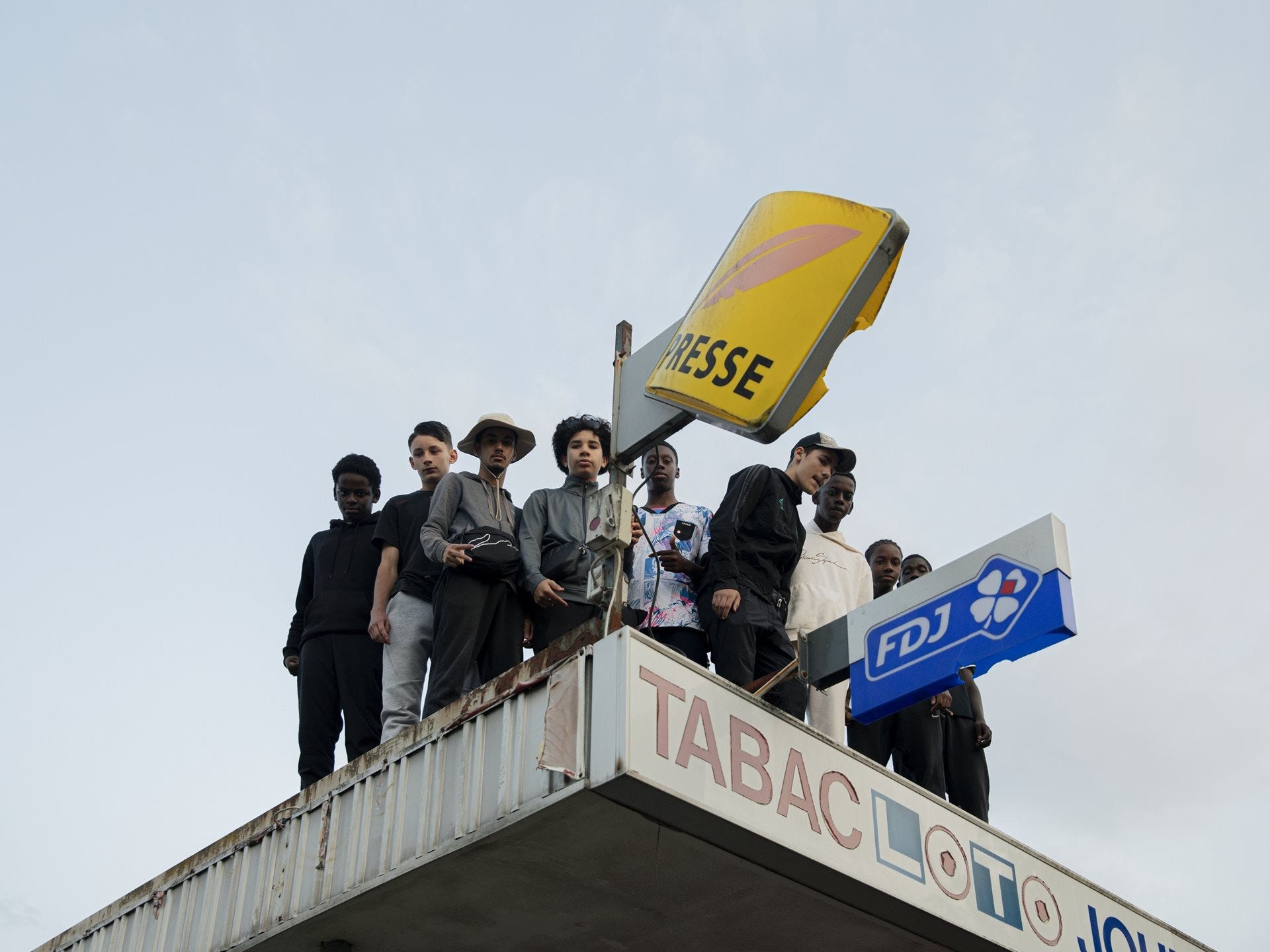
William Keo made this photograph. He grew up in communities like this one, the peripheral neighbourhoods of France where migrant families navigate postcolonial legacies and structural exclusion. His work isn’t styled. It’s inhabited. The image doesn’t look the way it looks because someone made decisions about the angle. It looks that way because he knows exactly where to stand.
I can learn an angle. I can’t learn that.
There was one image I didn’t say much about, walking through. Saber Nuraldin’s photograph of hundreds of people in Gaza climbing over rubble to reach an aid truck. The person I was with and I both stopped in front of it, and neither of us said anything for a while, and then we kept moving. Nuraldin was born in Gaza. He’s been photographing life there since 1997. What these images keep returning me to, all of them, is something very simple that gets buried under the complexity of the world: how much we all have in common. Wanting to be safe. Wanting our people close. Wanting a door to close behind us at night.
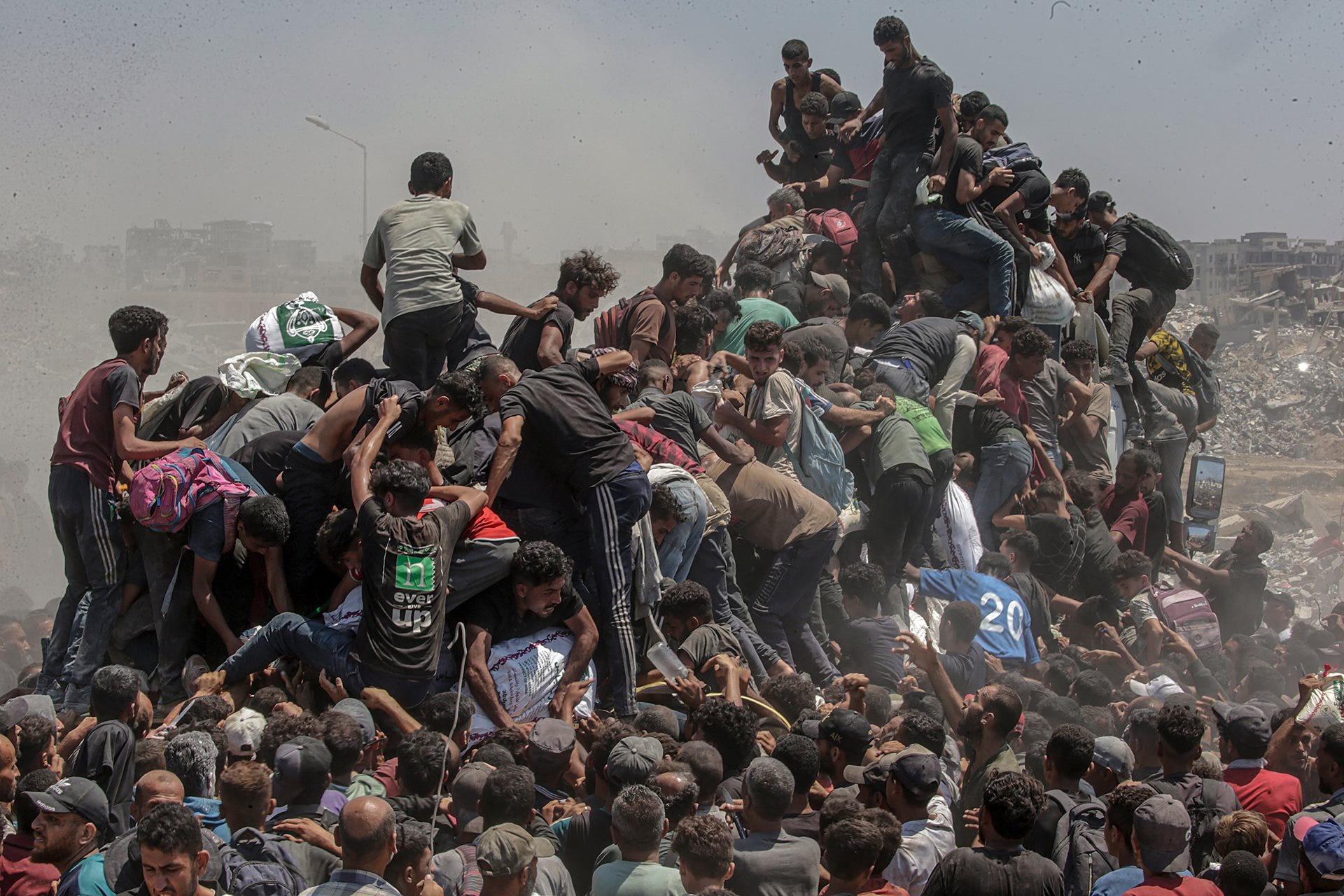
I only know what it means to stand in front of that image in a church in Amsterdam on a public holiday, shuffling slowly forward, carrying the weight of it the only way I can. Which is to keep looking, and to leave slower than I arrived.
That’s what it changed. Not my eye exactly. More the speed of it.
The perfected image, I’ve been thinking since, is a form of distance. The resolved composition, the considered light, everything made to feel inevitable: these are also ways of keeping the world at arm’s length. I’m not sure I want to stop making beautiful things. But I want to be more honest about what beauty costs. What it smooths over. What it can’t hold.
The images that stayed with me were the ones that didn’t try to be beautiful and ended up there anyway. Or the ones that had no interest in beauty at all and were more powerful for it. None of them needed my notes. None of them asked.
That’s not something I encounter very often. It’s worth going back for.
World Press Photo 2026 is at De Nieuwe Kerk, Amsterdam, until 27 September.
This feels like an invitation to go to the "Nieuwe Kerk" to see with my eyes what your eyes saw.